


Your Questions, Answered
-
Midwives are trained healthcare providers specializing in pregnancy and the childbearing years. Midwives are experts in normal physiological pregnancy, birth, and postpartum.
According to Midwives Alliance of North America, “The midwife is recognized as a responsible and accountable professional who works in partnership with the client to give the necessary support, care and advice during pregnancy, labour and the postpartum period, to conduct births on the midwife’s own responsibility and to provide care for the newborn and the infant. This care includes preventative measures, the promotion of normal birth, the detection of complications in mother and child, the accessing of medical care or other appropriate assistance and the carrying out of emergency measures.”
There are different types of midwives practicing in different settings. Kennedy and Sarah are a Certified Professional Midwives, credentialed by the North American Registry of Midwives, and are both licensed in Rhode Island by the Rhode Island Department of Health. They are also certified in basic life support, CPR, and neonatal resuscitation. Midwives are also expected to complete continuing education units yearly to maintain certification.
Click here to find out more about midwifery.
-
Since out of hospital midwives care for low risk pregnancies, birthing out of the hospital is considered a safe option by many organizations, communities and families. For people who experience complications during their pregnancy, birthing in the hospital may be a safer option. To read more about current research of the safety of home birth, click the links below.
Outcomes of planned out of hospital births attended by CPMs in North America
Outcomes of planned home birth with midwives vs planned hospital birth with midwife or physician
Planned home birth presents little risk where midwifery is well integrated
Other benefits to working with a midwife include:
Continuity of care: midwives generally see you longer (hour long visits) so that we get to know you. It’s important that you feel safe and supported during birth and feel trusting of those around you, including your care team. Midwives also see their clients more frequently in the postpartum so that we can provide not only support, but also resources where our clients may need.
Individualized care: every person is unique in their values, beliefs, and lived experiences. Midwives take this into consideration when collaborating with their clients to make a care plan.
Evidence informed care: you deserve to have up to date information regarding pregnancy, birth, and postpartum. Midwives value up to date information so that you can make the best decisions regarding your body and your care.
Uninterrupted birth: when planning a home birth, you don’t have to worry about rushing around and changing your environment. Instead you can focus on the one thing that matters most, birthing your baby.
For many families, this combination of individualized care, minimal intervention, and deep respect for the birth experience combined with the skills, experience and evidence-informed practices from their midwifery team, home birth a safe, empowering, and rewarding alternative to hospital-based obstetrical care.
-
Visits with a midwife tend to be longer than those with an OB because we have the luxury of time and a smaller client load. Visits are anywhere between 45 minutes to an hour so that we make sure to answer all your questions and address your concerns. Because care with our clients is collaborative, we discuss at length any testings/options/recommendations that come up during your care so that you feel informed and empowered to make the right decisions for your body.
We also do all the clinical things! We draw labs if we need (usually your first visit and around 28 weeks), we take your vitals, and feel your belly to see where baby is hanging out so we can listen to their heart beat.
-
We often get asked, “since I’m working with a midwife, do I need a doula?” Our answer is, if this is your first birth, and you have the resources to hire a doula, do it! We love working with doulas, and we believe doulas provide extra support during labor, birth, and the postpartum. Especially if you have never given birth before, doulas can help provide additional emotional and physical support.
You may also consider postpartum doula services. Many times, midwives and their clients have aligned perspectives on birth and the birthing space, and can provide support for their clients in a way that honors their interests and expectations during birth. However, postpartum is a time where more focus and attention can make a huge difference for the transition into parenthood.
-
Yes, we are happy to assist you in having and birth in the water and see so many benefits to hydrotherapy during labor. Woven Community Midwives have a handful of birth pools that we lend to our families. We often are there to help set it up or fill it as well as taking care of emptying it and breaking it down. The only items you will need to supply is a birth tub liner, and a brand new hose for filling and emptying.
-
Home birth is surprisingly not as messy as you might imagine! However, we do not leave your space until it is as clean as when we arrived. If you have a water birth, or a birth tub, we empty it for you with a sump pump that we provide, and clean it and break it down for you. We also generally start a load of laundry for you with the birth towels and linens before leaving as well.
-
Client safety is our highest priority at, which is why we attend every birth with at least two fully-trained midwives. This ensures that there are plenty of hands in case a complication were to arise. It also ensures that there is a midwife to help with baby’s transition in the postpartum, and a midwife to help with the parent’s transition. Kennedy and Sarah attend most births together, but call in other trained community midwives in cases of off call time or if two labors are happening at once.
Your birth team is highly up to you apart from a two midwife team. Your support team can include your partner, doula, family members, friends, etc. Remember that birth is raw and can feel vulnerable! With this in mind, cultivate a birth team that you can be authentically yourself around even in vulnerable moments. Your birth team should also be flexible to your needs; communicate with them ahead of time about some things you might like/dislike during labor, and emphasize that those might change the day of.
-
We find it very important that everyone on your birth team is supportive of your plan. However, we also recognize that it may feel scary for some partners to see their loved one choose something they are unfamiliar with when it comes to birth. We encourage you to bring your partner or family members to your appointments, especially if they are feeling uneasy about the home birth plan. Often, we am able to answer their questions, and address their concerns so they leave the appointment feeling much more informed. We want to “shine a light” on what might be causing fear, because often, if we walk through those fears, we can see that we have a plan for each scenario.
-
Midwives bring quite a lot of supplies and equipment into your space during labor that we fit into a couple packs. Our packs include emergency equipment such as IV fluids, oxygen, as well as a full neonatal resuscitation set up. Most of our emergency equipment usually doesn’t get pulled out, but we keep it close by. We also carry medications to manage bleeding in the postpartum as well as instruments and suture material in case we need to repair a tear. We also carry herbs, homeopathics and a birth stool to support the many stages of labor.
-
Midwives are trained to recognize yellow flags in labor, before they become red flags. However, in rare cases, emergencies may happen. Midwives are trained in obstetrical and neonatal emergencies until they can have additional support from EMS. You will always have two midwives at your birth to ensure your and your baby’s safety. If we ever need to call EMS, there will be a lot of communication with you about what is happening. We will manage the complication until EMS arrives, and then continue to help manage in the ambulance until we can get to higher level care at the hospital. The ambulance will take us to the closest hospital and we will provide a report and any records needed so they can give you the most appropriate care upon arrival. We hand over the clinical care but remain as a supportive provider and advocate in the hospital setting.
-
If a pregnancy complication arrises where we need to transfer your care prenatally, we will give you a few OB referrals. Depending on where you are in your care, we may continue tandom care if you wish (continuing our visit schedule, along with your OB schedule). If you are 35 weeks or later, we will plan to attend your birth in the hospital with you, and follow up after the birth with our standard postpartum schedule.
If there is a need to transfer your care during labor, we will call ahead, fax records, and make sure there is a room available for us. Generally we will go by car into the hospital unless there is a need for an ambulance. We will go with you to the hospital and get you settled.
-
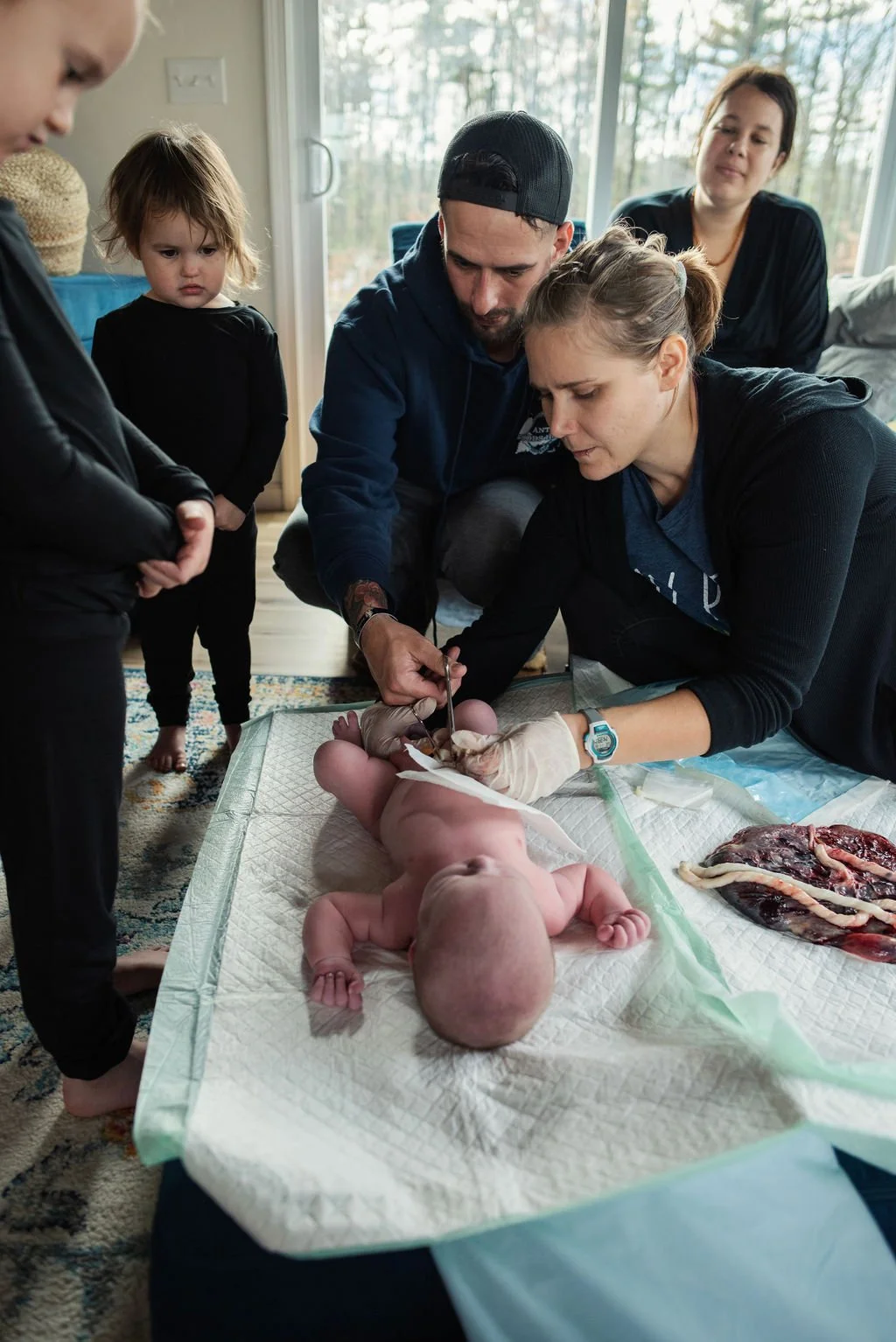
Midwives typically stay at your home after the birth anywhere from 2-4 hours. The immediate postpartum at home is slow moving and calm so that you can focus on bonding with your new family member. We want to make sure that you and your baby transition perfectly and that both of your vitals are reassuring. We make sure that you have had a meal, been able to empty your bladder, and have latched your baby if your plan is to body-feed. We also make sure that your space is all cleaned up prior to leaving. Midwives perform a full head to toe newborn assessment on baby. We don’t leave until we give you “postpartum expectations and instructions” which are basically exactly that: what to expect for the next 24 hours, and reasons to call.